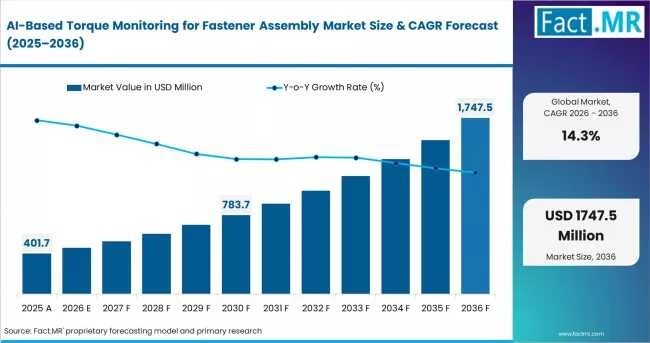
The AI-Based Torque Monitoring for Fastener Assembly Market is segmented by Component (Torque Sensors, Controllers, Software Analytics, and Edge Devices)
ROCKVILLE, MD, UNITED STATES, April 14, 2026 /EINPresswire.com/ — According to Fact.MR’s latest analysis, the Germany AI-based torque monitoring for fastener assembly market is valued at approximately USD 58.6 million in 2025, and is projected to reach USD 65.9 million in 2026, expanding to USD 257.3 million by 2036. The market is expected to grow at a CAGR of 14.4% during the forecast period, creating an incremental opportunity of over USD 190 million.
The market is undergoing a structural transformation driven by Germany’s strong push toward Industry 4.0, where digital quality assurance and intelligent assembly systems are replacing conventional torque tools. Increasing demand for zero-defect production, traceability, and predictive quality control is reshaping fastening operations across automotive and industrial manufacturing.
Get detailed market forecasts, competitive benchmarking, and pricing trends:
https://www.factmr.com/connectus/sample?flag=S&rep_id=14706
Quick Stats
Market Size (2025): USD 58.6 Million
Market Size (2026): USD 65.9 Million
Forecast Value (2036): USD 257.3 Million
CAGR (2026–2036): 14.4%
Incremental Opportunity: ~USD 190 Million
Leading Segment: On-premise deployment (44% share)
Leading Component: Torque sensors (38% share)
Leading Industry: Automotive manufacturing
Key Players: Atlas Copco AB, Bosch Rexroth AG, Desoutter Industrial Tools, Kistler Group, SCS Concept Group
Executive Insight for Decision Makers
Germany’s manufacturing ecosystem is shifting from reactive quality inspection to predictive assembly intelligence.
Strategic Shift: Transition toward AI-driven torque analytics integrated with robotic assembly lines
What Industry Must Do:
Invest in sensor-enabled torque tools with AI analytics
Integrate systems with PLC and MES platforms
Build data traceability infrastructure for compliance (IATF 16949)
Risk of Inaction:
Increased product recalls and warranty costs
Loss of competitiveness in precision engineering and automotive exports
Inability to meet digital manufacturing standards
Market Dynamics
Key Growth Drivers
Strong automotive production base requiring precision fastening
Adoption of AI-enabled quality assurance systems
Rising need for real-time torque verification
Increasing focus on traceability and compliance
Key Restraints
Integration complexity with legacy assembly systems
High upfront cost of AI-enabled torque solutions
Validation challenges for machine learning reliability
Emerging Trends
Integration with robotic and automated assembly lines
Use of torque-angle signature analytics
Expansion of predictive maintenance models
Growth in digital twin-based assembly simulations
Segment Analysis
Leading Segment:
On-premise deployment (44%) dominates due to low-latency requirements in real-time assembly environments
Fastest-Growing Segment:
AI analytics platforms enabling anomaly detection and predictive insights
By Component:
Torque sensors (38%) lead due to precision measurement requirements
By Application:
Automotive assembly remains dominant
Electronics assembly shows rapid growth
Strategic Importance:
High-precision fastening is critical in safety-critical systems, making AI-based torque monitoring indispensable for German OEMs.
Supply Chain Analysis (Critical Insight)
Raw Material Suppliers:
Sensor-grade materials, microelectronics, and industrial-grade alloys
Component Manufacturers:
Torque sensor manufacturers
Embedded system and chip providers
System Integrators / OEMs:
Companies like Atlas Copco and Bosch Rexroth integrate hardware + AI software
Distributors & Integrators:
Industrial automation solution providers
Smart factory system integrators
End-Users:
Automotive OEMs (primary buyers)
Industrial machinery manufacturers
Electronics assembly companies
Who Supplies Whom:
Sensor manufacturers → Tool/system manufacturers → Automation integrators → Automotive & industrial OEMs
This tightly integrated chain ensures real-time torque monitoring capability embedded directly into assembly workflows.
Pricing Trends
Commodity vs Premium:
Basic torque tools remain commoditized
AI-enabled systems command premium pricing (2–4x higher)
Key Pricing Influencers:
Sensor accuracy and durability
AI software capabilities
Integration complexity
Certification requirements
Margin Insights:
High margins in software analytics and services
Moderate margins in hardware components
Regional Analysis (Germany Focus with Benchmarking)
Top Countries by CAGR
China – 15.2%
India – 14.8%
United Kingdom – 14.6%
Germany – 14.4%
United States – 14.3%
Germany Growth Drivers
Strong automotive and machinery manufacturing base
Government-backed Plattform Industrie 4.0 initiatives
High adoption of digital quality assurance systems
Developed vs Emerging Markets
Germany: Focus on precision, compliance, and innovation
Emerging markets: Focus on cost efficiency and scale deployment
Competitive Landscape
Market Structure: Moderately consolidated
Key Players
Atlas Copco AB
Bosch Rexroth AG
Desoutter Industrial Tools
Stanley Black & Decker Inc.
Ingersoll Rand Inc.
Kistler Group
SCS Concept Group
Mountz Inc.
Cleco (Apex Tool Group)
Crane Electronics Ltd
Competitive Strategies
Product innovation in AI-driven torque analytics
Expansion of connected assembly solutions
Strategic partnerships with automotive OEMs
Focus on aftermarket services and software upgrades
Strategic Takeaways
For Manufacturers
Invest in AI-enabled torque monitoring ecosystems
Focus on integration with smart factory systems
For Investors
Target companies with strong software + hardware capabilities
High ROI potential in predictive quality solutions
For Distributors
Build expertise in system integration and customization
Offer end-to-end digital assembly solutions
Future Outlook
Germany’s market is expected to evolve into a fully digitized fastening ecosystem, where:
AI systems autonomously optimize torque application
Integration with digital twins and smart factories becomes standard
Sustainability drives efficient material usage and reduced rework
Long-term growth will be anchored in precision engineering excellence and export-driven manufacturing leadership.
Conclusion
The Germany AI-based torque monitoring for fastener assembly market is entering a high-growth, innovation-driven phase, underpinned by Industry 4.0 adoption and stringent quality requirements. Companies that invest in AI-driven fastening intelligence, real-time analytics, and system integration will be best positioned to capture long-term value.
Why This Market Matters
In Germany’s advanced manufacturing landscape, fastening precision directly impacts product safety, reliability, and brand reputation. AI-based torque monitoring is no longer optional—it is a critical enabler of zero-defect manufacturing and global competitiveness.
Full Report: Unlock 360° insights for strategic decision making and investment planning-
https://www.factmr.com/checkout/14706
To View Related Report:
Torque Sensor Market https://www.factmr.com/report/torque-sensor-market
Digital Torque Tools Market https://www.factmr.com/report/digital-torque-tools-market
Assembly Robot Market https://www.factmr.com/report/assembly-robot-market
Fasteners Packaging Market https://www.factmr.com/report/fasteners-packaging-market
S. N. Jha
Fact.MR
+1 628-251-1583
email us here
Legal Disclaimer:
EIN Presswire provides this news content “as is” without warranty of any kind. We do not accept any responsibility or liability
for the accuracy, content, images, videos, licenses, completeness, legality, or reliability of the information contained in this
article. If you have any complaints or copyright issues related to this article, kindly contact the author above.

Media gallery