
There is a moment in every buyer’s journey where a decision gets made. Not the research stage, not the awareness stage — the final stage, where someone types a question and acts on the answer. For local service providers, that moment is increasingly handled by an AI assistant. And for most of them, it passes without their name ever coming up.
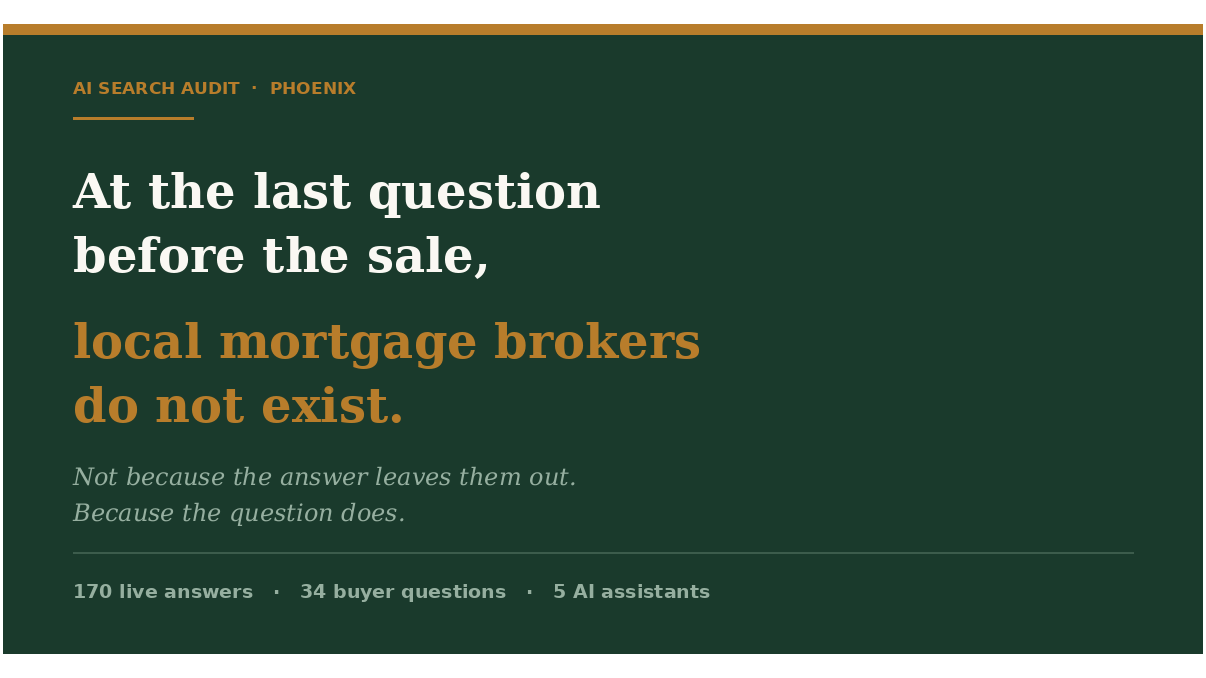
I measure what AI assistants say when somebody is looking for a service. Last week, I ran it on an established independent mortgage brokerage in Phoenix. Own brand, own website, years in business, real reviews. Thirty-four questions a borrower would actually type, put to five major assistants. One hundred and seventy live answers.
They were named six times. Rocket Mortgage was named thirty-three.
Known by name, absent at decision time
The audit also runs six control questions that include the company name. Is this brokerage legitimate? What are their reviews like? How do they compare to the big lenders?
Six out of six. Every assistant knew them, answered clearly, and cited their own website as the source.
So this is not a business the machines have never heard of. It is a business the machines know perfectly well and never bring up when it counts.
That distinction matters more than any other number in this piece. Being known by an AI and being recommended by one are two entirely different behaviors. Strong local rankings do not bridge the gap between them. Assistants condense many eligible businesses into a short list, and most local providers never make the cut — not because the assistant lacks information about them, but because something else pushes them out of the frame.
The part I did not expect
The thirty-four questions are grouped by how close the buyer is to deciding. The last group has six questions: someone who knows what they need and is choosing a provider. The final question before the sale.
This brokerage appeared in none of them.
Then I read the six questions themselves. Is Quicken better than Rocket Mortgage? Guaranteed Rate versus Better. Should I use a local lender or Wells Fargo? Fairway reviews. Guild versus Caliber. LoanDepot customer service complaints.
Every single one is a comparison between national brands. Not one contains the possibility of a local provider at all. One asks whether to use “a local lender” — as an unnamed category— against a bank that has a name.
The brokerage is not losing that comparison. It is not in it. By the time a buyer reaches the moment of choosing, the vocabulary they choose from has been set upstream, and it contains six national names and one anonymous category.
Why this happens
An assistant answers with what has been written about, and national brands have been written about endlessly. Comparison articles, review roundups, complaint threads, news coverage, forum arguments. Twenty years of the internet arguing about the same handful of names.
Almost nobody writes “Should I use this Phoenix broker or Wells Fargo?” So that sentence does not exist for the assistant to learn from, and the question it forms is built from the sentences that do. The bias is not programmed in. It is built by volume, and it compounds. Every year that passes without third-party content about a local provider widens the gap.
Why can’t your own website fix this
A well-built local website does one thing well: it answers questions about that business. When someone asks about the business by name, it works — in the Phoenix audit, it was cited every single time.
But the decision-stage questions are not about any one business. They are about the category. Which lender is better? Which type of provider is safer? Which option gives more flexibility? Those questions get answered on other people’s pages: review aggregators, financial media, consumer forums, trade publications. A local provider’s own website has no presence there.
What a measurement actually shows
For most local providers, the pattern is consistent: present when asked directly, absent when a buyer is choosing. That gap between being known and being recommended is where the revenue goes.
A measurement also shows which names are filling the space. In the Phoenix case, Rocket Mortgage, Guaranteed Rate, loanDepot, Fairway, and Movement took almost all of it. The local brokerage accounted for 9% of brand mentions in its city and category.
There is a fourth finding, quieter than the others. The one local outcome in that whole set of decision questions was the phrase “a local lender” — no name, no reviews, no track record, a placeholder standing in for every independent provider in the city at once. Somebody will eventually own that sentence. At present, nobody does.
Measure it rather than assume it
The starting point is measurement. Not guessing or assuming that strong Google rankings translate into AI recommendations. Running the questions a real buyer would ask and seeing what comes back. Which names appear, at what stage, with what framing, and which questions has nobody in the local market claimed yet?
Autonomous Growth helps local service providers find out where they stand. autonomousgrowth.io autonomousgrowth.io.
Autonomous Growth ( part of RReputatioNN )
109 Sint-Lenaartsesteenweg #1
1
Rijkevorsel
Antwerpen
2310
Belgium


