CHANGSHU, JIANGSU, CHINA, October 26, 2026 /EINPresswire.com/ — Developing a high-capacity Fiber Cement Board Production Line requires bridging mineral slurry rheology with high-speed sheet lamination, hydraulic pressing, and high-pressure steam autoclaving. Engineering teams evaluate regional Portland cement grades, silica sand fineness, and cellulose reinforcement fibers to select between Hatschek wet forming and continuous flow-on technologies. Single-point turnkey contracting coordinates raw material dosing, forming cylinders, autoclaves, and finishing sanders into an integrated operational facility.
Fiber cement boards provide non-combustible, moisture-resistant, and termite-proof architectural panels for exterior facades, interior drywall, ceiling tiles, and acoustic underlayment. Delivering consistent flexural strength exceeding ten megapascals demands uniform fiber dispersion, high laminate green strength, and controlled hydrothermal curing across every production batch.
Hatschek Wet Forming Technology Versus Flow-on Slurry Processes
Selecting the primary wet sheet forming technology establishes board density potential, thickness uniformity, and continuous production speeds. Process engineers evaluate target product portfolios to choose the optimum mechanical forming configuration.
Hatschek Cylinder Wet Forming: Rotating wire-mesh vat cylinders filter dilute aqueous slurries of cement, silica, and refined cellulose fibers, transferring thin film lamellas onto continuous permeable dewatering felts.
Accumulating Size Roll Laminating: Successive microscopic slurry films wrap around a heavy size roll under pneumatic pressure, accumulating layer by layer until an automated cut-off wire severs the green sheet at the target caliper.
Continuous Flow-on Extrusion Alternative: Direct slurry deposition onto moving dewatering wire screens suits thick architectural boards and high-density exterior structural panels exceeding twenty millimeters thickness.
Hatschek forming delivers superior multi-ply interlaminar bonding and directional fiber alignment, achieving high elasticity moduli in thin boards between four and twelve millimeters. Automated slurry consistency controllers continuously regulate vat solids concentrations between six and ten percent, preventing sheet delamination. Specialized synthetic dewatering felts utilize needle-punched polyamide structures engineered for high water permeability and chemical resistance. High-vacuum suction boxes positioned beneath running felts extract free water, lowering green sheet moisture below thirty percent prior to the size roll.
Automated slurry recirculation loops maintain continuous fluid agitation across all vats, preventing heavier silica and cement particles from settling out. Ultrasonic slurry level sensors modulate pneumatic diaphragm control valves in real time, keeping vat submersion depths perfectly constant during multi-shift campaigns.
High-Pressure Autoclaving Kinetics and Board Curing Metallurgy
Curing mechanisms govern board dimensional stability, long-term freeze-thaw durability, and moisture movement coefficients. Hydrothermal synthesis converts amorphous calcium silicate hydrates into crystalline tobermorite matrices.
Heavy Hydraulic Stack Pressing: Multi-daylight hydraulic presses exert pressures up to ten thousand kilonewtons on stacked green boards, compacting the mineral matrix, reducing internal porosity, and boosting density above 1.4 g/cm³.
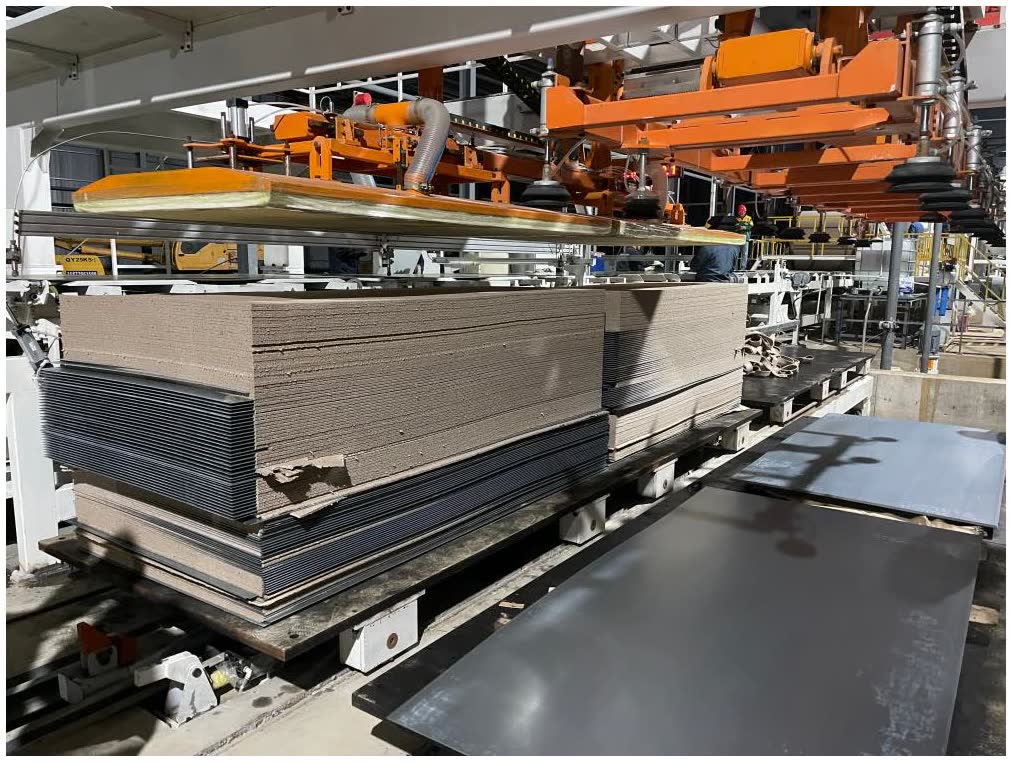
Pre-Curing Tunnel Conditioning: Automated transfer cars transport green boards through temperature-controlled pre-curing tunnels at 50°C, providing initial hydration strength for automated vacuum de-stacking.
High-Pressure Steam Autoclave Synthesis: Horizontal steel autoclaves cure green boards under saturated steam at 170°C to 190°C and pressures of eight to twelve bar for eight to twelve hours.
Hydrothermal reaction between finely ground quartz sand and Portland cement forms crystalline 1.1-nanometer tobermorite, drastically reducing reversible moisture expansion. Autoclaved fiber cement boards exhibit minimal shrinkage and will not warp or crack when exposed to severe exterior climate cycles. Autoclave pressure vessels feature quick-opening hydraulic safety doors equipped with dual mechanical interlocks that prevent door opening while residual pressure remains inside. Automated condensate recovery systems drain thermal water continuously, returning flash steam to boiler feed circuits.
Rail-mounted automated transfer shuttles maneuver multi-tier steel autoclave carts into vessel chambers without manual intervention. Multi-point temperature sensors track steam thermal gradients across the entire autoclave length, guaranteeing uniform hydrothermal reaction completion from front to rear cart stacks.
Precision Calibrating, Trimming, and Sanding Machinery Trains
Autoclaved boards undergo automated surface calibrating, four-edge squaring, and surface finishing before packaging. High-precision mechanical finishing ensures compliance with international building board dimensional tolerances.
Heavy-Duty Thickness Calibrating: Diamond-tipped milling cutter heads plane cured board surfaces, maintaining overall thickness tolerances within plus or minus 0.2 millimeters across wide boards.
Four-Edge Trimming and Chamfering: High-speed circular diamond saw stations trim board widths and lengths square, routing precision tongue-and-groove joints or beveled edge details.
Wide-Belt Multi-Head Sanding: Progressive grit sanding heads polish board faces from eighty down to two hundred forty mesh, producing silky surfaces ready for direct factory priming or architectural painting.
Integrated high-volume baghouse dust collectors capture mineral and silica dust generated during high-speed cutting and sanding. Automated spark detection and extinguishing systems protect dust ductwork, maintaining clean working environments and meeting strict occupational safety standards. Vacuum-cup robotic stackers stack finished boards onto wooden pallets, and automatic strapping machines apply protective stretch hoods for weather-tight ocean container transport.
Turnkey Engineering Delivery and Equipment Fabrication Governance
Executing an international fiber cement manufacturing project requires unified engineering governance across raw material slurry preparation, precision forming machinery, and pressure vessel installation. Working with an experienced contractor such as Suzhou CMT provides comprehensive single-point EPC delivery compliant with international ASME pressure vessel, CE machinery directives, and ISO 9001 quality management benchmarks. Coordinated multi-base manufacturing centers fabricate slurry turbo-mixers, stainless steel forming vats, and heavy hydraulic presses under strict quality assurance oversight. Comprehensive factory acceptance testing verifies cylinder concentricity, hydraulic power pack pressures, and central distributed control programming before dispatch.
Specialized mechanical installation crews oversee site foundation leveling, autoclave anchoring, high-pressure steam piping installation, and central motor control center energization. Detailed quality hold points ensure all pressure piping passes radiographic inspections before thermal insulation is installed.
Systematic Commissioning, Slurry Balancing, and Operational Handoff
Structured commissioning mitigates early operational delays and protects delicate forming felts during initial production trials. Phased execution ensures a seamless progression from dry mechanical cycling to full commercial output.
Water Runs and Hydraulic Commissioning: Forming sections circulate process water to verify felt guide tracking, high-pressure oscillating needle shower cleaning, and vacuum dewatering performance.
Slurry Dosing and Lamination Dry Runs: Raw fiber pulpers and cement weigh-feeders run calibration recipes to confirm continuous batching accuracy and size roll cut-off responsiveness.
Commercial Performance Guarantee Testing: Continuous seventy-two-hour commercial production runs verify daily board output tonnage, thickness tolerance stability, and autoclave steam consumption per square meter.
Comprehensive classroom instruction and control room console training prepare local operating teams for fiber refining adjustments, felt washing maintenance, and autoclave cycle sequencing. Detailed operating manuals provide preventative maintenance routines and troubleshooting decision trees for all critical mechanical drives. Building materials executives and plant project directors can evaluate turnkey fiber cement board engineering specifications directly at https://www.cmtproject.com/ to inspect verified production lines.
Suzhou CMT Engineering Co., Ltd.
Suzhou CMT Engineering Co., Ltd.
Legal Disclaimer:
EIN Presswire provides this news content “as is” without warranty of any kind. We do not accept any responsibility or liability
for the accuracy, content, images, videos, licenses, completeness, legality, or reliability of the information contained in this
article. If you have any complaints or copyright issues related to this article, kindly contact the author above.

Media gallery