The Business Research Company’s Stem Cell Therapy Global Market Report 2026 – Market Size, Trends, And Forecast 2026-2035
LONDON, GREATER LONDON, UNITED KINGDOM, October 27, 2026 /EINPresswire.com/ — The stem cell therapy market is rapidly evolving as a vital segment within the broader pharmaceutical and regenerative medicine industries. With significant advancements in clinical applications and manufacturing processes, this market showcases strong growth potential driven by innovation, increasing demand, and expanding research efforts. Below is an overview of the market’s size, leading regions, segments, drivers, key players, and emerging trends shaping its future.
Market Size and Comparative Outlook of the Stem Cell Therapy Market
The stem cell therapy market is projected to exceed $16 billion by 2030, representing nearly half of the larger Cell Therapy market estimated at around $32 billion in the same year. Within the vast Pharmaceuticals industry, which is expected to reach $2,496 billion by 2030, stem cell therapy will constitute close to 1% of the total market value. This highlights the growing significance of regenerative medicine as a specialized yet impactful sector.
Request A Free Sample Of The Stem Cell Therapy Market Report
https://thebusinessresearchcompany.com/sample_request?id=32306372&type=smp&name=Stem%20Cell%20Therapy%20Market%20Report%202026&utm_source=EINPresswire&utm_medium=Paid&utm_campaign=Oct_PR
North America’s Role as the Dominant Region in Stem Cell Therapy by 2030
North America is set to remain the largest market for stem cell therapy in 2030, with an anticipated value of $6.2 billion. From $4.1 billion in 2025, this region is forecasted to grow at a compound annual growth rate (CAGR) of 8%. This robust expansion is fueled by increasing clinical adoption of regenerative treatments, heightened regulatory approvals, and a surge in late-stage trials for stem cell-based therapies. Additionally, investments from biotech startups and venture capital firms, along with advancements in stem cell manufacturing technologies and hospital capabilities, are propelling market growth. Strong patient demand for innovative treatments addressing chronic and degenerative diseases across the USA and Canada further supports this trend.
The USA as the Largest National Market within the Global Stem Cell Therapy Landscape
In 2030, the United States is expected to hold the top position globally in stem cell therapy, valued at $5.4 billion. The market is predicted to expand from $3.8 billion in 2025, growing at a CAGR of 7%. This growth is attributed to expanding clinical application of both autologous and allogeneic stem cell treatments, particularly in orthopedic, cardiovascular, and neurological fields. The establishment of specialized manufacturing and processing facilities, increased participation of academic centers in regenerative medicine trials, and supportive regulatory frameworks facilitating accelerated approval pathways are important contributors. Furthermore, strong collaborations between biotechnology firms and healthcare providers across the country enhance innovation and accessibility.
Access The Detailed Stem Cell Therapy Market Report Here
https://thebusinessresearchcompany.com/report/Stem-Cells-Therapy-global-market-report?utm_source=EINPresswire&utm_medium=Paid&utm_campaign=Oct_PR
Dominance of Allogeneic Stem Cell Therapy Segment in Market Share by 2030
Among stem cell therapy types, allogeneic stem cell therapy is projected to be the largest segment, comprising 63% or about $10 billion of the market by 2030. This segment’s growth is driven by the rising availability of off-the-shelf therapies, which enable quicker patient treatment. Improvements in donor screening, immune compatibility matching, scalable manufacturing, and engineered cell lines with consistent therapeutic effects are key enablers. Clinical protocols aimed at reducing rejection risks along with automated cell expansion and preservation technologies further strengthen this segment’s position.
Detailed Segmentation of the Stem Cell Therapy Market
The stem cell therapy market is divided based on cell source into adult stem cells, induced pluripotent stem cells, and embryonic stem cells. In terms of applications, the market covers musculoskeletal disorders and wounds & injuries, cancer, autoimmune disorders, and other medical conditions. End users include hospitals and clinics, research centers, and other healthcare facilities, reflecting the broad utility and growing adoption of these therapies across medical and scientific domains.
Projected Compound Annual Growth Rate Leading to 2030
The stem cell therapy market is expected to grow at a strong CAGR of 11% through 2030, reflecting increasing investments, clinical acceptance, and technological progress within the sector.
Funding as a Major Growth Catalyst for Stem Cell Therapy
One of the primary factors propelling the stem cell therapy market is the surge in funding allocated to stem cell research. Support from governments, private investors, and biotech companies is crucial in enabling the development of novel regenerative therapies targeting chronic and degenerative diseases. This financial backing facilitates advances in stem cell processing technologies, enhances treatment safety, and broadens therapeutic applications across various medical disciplines. Collaborative efforts among research institutions, pharmaceutical firms, and healthcare providers benefit from these investments, accelerating innovation and regulatory approvals. Consequently, increased funding for research contributes an estimated 2.3% annual growth to the market.
Chronic Disease Prevalence as a Key Driver of Market Demand
The growing incidence of chronic diseases worldwide is a significant driver for the expansion of the stem cell therapy market. Conditions such as cancer, cardiovascular ailments, diabetes, orthopedic problems, and neurological disorders demand advanced therapeutic solutions that can promote tissue repair and functional recovery. Stem cell treatments hold promise for slowing disease progression and improving patient outcomes compared to traditional therapies. Demographic shifts, including aging populations and lifestyle changes, are contributing to a rising number of patients needing such therapies. This factor is expected to add around 1.9% to the yearly market growth.
Role of Clinical Trials in Accelerating Stem Cell Therapy Adoption
The increasing volume of clinical trials focused on stem cell therapies is another key growth catalyst. These trials provide essential evidence validating the safety and efficacy of treatments for a variety of conditions including cancer, autoimmune diseases, neurological disorders, and tissue regeneration. Active involvement from pharmaceutical and biotechnology companies, alongside research institutions, helps drive regulatory approvals and build confidence among healthcare professionals and patients. Positive clinical trial results also stimulate further investments and partnerships aimed at expanding therapy availability. Clinical trial activity is projected to support about 1.7% annual market growth.
Emerging Opportunities in Allogeneic and Autologous Stem Cell Therapy Markets
Significant growth prospects exist in both allogeneic and autologous stem cell therapy segments, expected to contribute over $6 billion combined by 2030. Market expansion is fueled by commercialization of advanced cell-based treatments, increasing adoption of precision regenerative medicine customized for individual diseases, and broader use of stem cell therapies in tissue repair and restoration. Investments in next-generation cellular engineering, including gene-edited stem cells, along with enhanced hospital adoption and improved long-term safety monitoring, are key factors. This trend reflects the intensifying focus on improving therapeutic effectiveness, personalizing care, and advancing regenerative healthcare.
Substantial Growth Forecast for Allogeneic and Autologous Therapies
From 2025 to 2030, the allogeneic stem cell therapy segment is projected to grow by $4 billion, while autologous therapy is expected to increase by $2 billion. The market is driven by a mixture of global biotechnology leaders and specialized regenerative medicine companies concentrating on innovative cell processing, scalable manufacturing, and stringent quality controls. Regulatory compliance, clinical validation, and personalized medicine approaches remain central to maintaining competitive advantage. For stakeholders, understanding this evolving landscape is crucial for identifying growth opportunities, fostering innovation, and forging strategic partnerships.
Market Leader and Competitive Landscape Overview
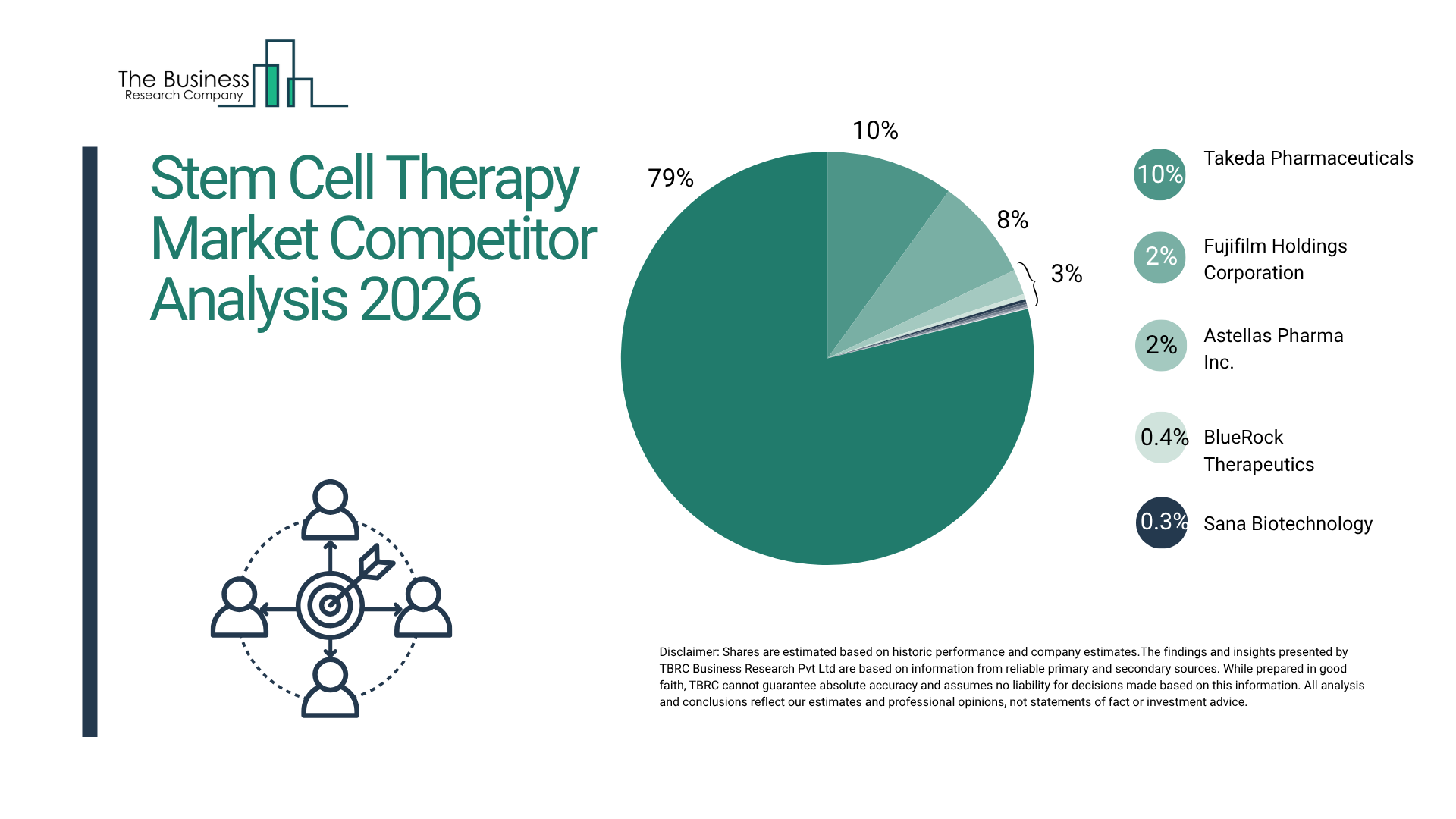
Takeda Pharmaceuticals is currently the leading company in the global stem cell therapy market, holding a 10% share of sales in 2025. Takeda’s regenerative medicine division offers a diverse range of cell therapy solutions, advanced platforms, and research-driven treatments that support the development and commercialization of cutting-edge regenerative healthcare applications.
Key Players Driving the Stem Cell Therapy Industry
Other notable companies active in this market include Fujifilm Holdings Corporation, Astellas Pharma Inc., BlueRock Therapeutics, Sana Biotechnology, Vericel Corporation, Mesoblast Ltd, Takara Bio Inc., JCR Pharmaceuticals Co. Ltd., Fate Therapeutics, Gamida Cell Ltd, Century Therapeutics, Lineage Cell Therapeutics, DiscGenics Inc., Anterogen Co. Ltd, Genenta Science, Stempeutics Research Private Limited, ReNeuron Group, MEDIPOST Co. Ltd., Pharmicell Co. Ltd., and Capricor Therapeutics.
Market Concentration and Competitive Intensity
The stem cell therapy market is moderately fragmented, with the top ten firms responsible for 21% of total revenue in 2025. Moderate barriers to entry stem from strict regulatory standards, complex manufacturing requirements, and the need for high safety and efficacy in cell-based therapeutics. Leading companies maintain their market positions through diverse therapy sets, research collaborations, advanced production capabilities, and expansive distribution networks. As demand for regenerative treatments and personalized medicine rises, strategic innovation and geographic expansion will be critical for sustaining competitive advantage.
Top Stem Cell Therapy Companies and Their Market Shares
The leading companies and their approximate market shares in 2025 are:
– Takeda Pharmaceuticals (10%)
– Fujifilm Holdings Corporation (8%)
– Astellas Pharma Inc. (2%)
– BlueRock Therapeutics (0.4%)
– Sana Biotechnology (0.3%)
– Vericel Corporation (0.2%)
– Mesoblast Ltd (0.2%)
– Takara Bio Inc. (0.2%)
– JCR Pharmaceuticals Co. Ltd. (0.1%)
– Fate Therapeutics (0.04%)
Key Suppliers Providing Raw Materials for Stem Cell Therapy
Major suppliers of critical raw materials for the stem cell therapy market include Thermo Fisher Scientific Inc., Merck KGaA, Lonza Group AG, Sartorius AG, Corning Incorporated, Danaher Corporation, Bio-Rad Laboratories Inc., Miltenyi Biotec B.V. & Co. KG, STEMCELL Technologies Inc., Takara Bio Inc., FUJIFILM Irvine Scientific Inc., Cytiva, Eppendorf SE, Becton Dickinson and Company, Avantor Inc., PromoCell GmbH, R&D Systems Inc., Cell Signaling Technology Inc., Charles River Laboratories International Inc., Nunc A/S, Greiner Bio-One International GmbH, BioLegend Inc., PeproTech Inc., Creative BioLabs Inc., and OriGene Technologies Inc.
Primary Wholesalers and Distributors Supporting Market Reach
The stem cell therapy supply chain is supported by key wholesalers and distributors including McKesson Corporation, Cardinal Health Inc., Cencora Inc., Medline Industries LP, Henry Schein Inc., VWR International LLC, Bio-Techne Distribution Network, GenScript Biotech Corporation, Nipro Corporation, DKSH Holding Ltd., Univar Solutions Inc., Brenntag SE, IMCD N.V., Azelis Group N.V., Eurofins Scientific Logistics, LabCorp Distribution Network, Quest Diagnostics Supply Services, PPD Inc. Distribution Services, Airgas Inc., Wesco International Inc., and Grainger Inc.
Major End Users Benefiting from Stem Cell Therapy Advancements
Hospitals, clinics, and research centers are the primary end users of stem cell therapies. Leading organizations in this space include Novartis AG, Bristol Myers Squibb Company, Gilead Sciences Inc., Vertex Pharmaceuticals Incorporated, Bluebird Bio Inc., CRISPR Therapeutics AG, Fate Therapeutics Inc., Mesoblast Limited, Gamida Cell Ltd., Vericel Corporation, Athersys Inc., Lineage Cell Therapeutics Inc., Sana Biotechnology Inc., Century Therapeutics Inc., Nkarta Inc., Allogene Therapeutics Inc., Orchard Therapeutics plc, Rocket Pharmaceuticals Inc., Autolus Therapeutics plc, Cynata Therapeutics Limited, ViaCyte Inc., Cellularity Inc., BrainStorm Cell Therapeutics Inc., Tessa Therapeutics Ltd., and Takeda Pharmaceutical Company Limited.
Innovations and Competitive Trends Transforming the Stem Cell Therapy Market
Automated microfluidic-based cell processing platforms are revolutionizing stem cell therapy manufacturing by enhancing scalability, consistency, and operational efficiency. For example, in March 2025, Limula SA introduced LimONE, an automated platform that streamlines both autologous and allogeneic cell therapy production. This system features closed processing, automated enrichment, and integrated formulation capabilities, which improve reliability, reduce variability, and support broader clinical and commercial use of cell therapies.
Strategies Companies Use to Maintain Market Leadership
Industry players are focusing on improving stem cell manufacturing quality and scalability, leveraging advanced cell processing technologies to enhance treatment outcomes. They are also broadening clinical applications to strengthen patient care and research, while adopting artificial intelligence tools for better product characterization and automation. These strategies collectively help companies stay competitive amid evolving regulatory standards and increasing market demands.
The 2026 edition of our market reports now delivers enhanced analytical coverage through market attractiveness scoring and analysis, total addressable market (TAM) analysis, company scoring matrix graphics and tables, Excel-based forecasting dashboards, market hotspots infographics, key technologies and future trend analysis, plus updated graphics and tables.
Learn More About The Business Research Company
The Business Research Company (www.thebusinessresearchcompany.com) is a leading market intelligence firm renowned for its expertise in company, market, and consumer research. We have published over 30,000+ reports across 27 industries and 60+ geographies. Our research is powered by 1,500,000 datasets, extensive secondary research, and exclusive insights from interviews with industry leaders.
We provide continuous and custom research services, offering a range of specialized packages tailored to your needs, including Market Entry Research Package, Competitor Tracking Package, Supplier & Distributor Package and much more.
Disclaimer: Please note that the findings, conclusions and recommendations that TBRC Business Research Pvt Ltd delivers are based on information gathered in good faith from both primary and secondary sources, whose accuracy we are not always in a position to guarantee. As such TBRC Business Research Pvt Ltd can accept no liability whatever for actions taken based on any information that may subsequently prove to be incorrect. Analysis and findings included in TBRC reports and presentations are our estimates, opinions and are not intended as statements of fact or investment guidance.
Contact Us:
The Business Research Company
Americas +1 310-496-7795
Europe +44 7882 955267
Asia & Others +44 7882 955267 & +91 8897263534
Email: marketing@tbrc.info
Follow Us On:
LinkedIn: https://in.linkedin.com/company/the-business-research-company
Oliver Guirdham
The Business Research Company
+44 7882 955267
info@tbrc.info
Visit us on social media:
LinkedIn
Facebook
X
Legal Disclaimer:
EIN Presswire provides this news content “as is” without warranty of any kind. We do not accept any responsibility or liability
for the accuracy, content, images, videos, licenses, completeness, legality, or reliability of the information contained in this
article. If you have any complaints or copyright issues related to this article, kindly contact the author above.

Media gallery